Colosseum Underground ToursTickets & Tours
Rome · Colosseum Hypogeum

Best Things to Do at Rome Colosseum Underground

The Colosseum Underground is where the amphitheatre changes from a famous monument into a working machine. Follow the corridors beneath the lost arena floor, identify the shafts used for ancient lifts, understand how animals and performers were moved into position, and connect the hidden backstage system with the spectacles seen by thousands above.

Most revealing detail Ancient lift shafts
Best spatial view Central corridor
Best context Underground + Arena
Look beyond the ruins How shows actually worked
Beneath the arena

Six things actually worth looking for in the Colosseum Underground

The hypogeum is easier to understand when you stop seeing it as a maze of walls. Its corridors, shafts and chambers were an operating system designed to move performers, animals and stage equipment beneath the arena.

01 Ancient technology

Find the shafts where lifts once rose toward the arena

The most important structures underground are easy to overlook: vertical shafts and working spaces connected to lifting systems that brought animals, people and scenery up through openings in the arena floor.

Why it matters The spectacle above depended on machinery below. The Underground turns the Colosseum from a static ruin into evidence of Roman stage engineering.
02 Hidden layout

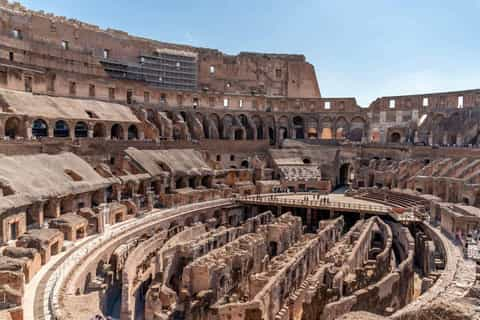
Use the central passage to understand the 14-corridor plan

The surviving Underground extends across roughly half a hectare. Fourteen corridors are visible, arranged symmetrically around the large central passage.

Look sideways The repeating corridors make more sense when viewed as an organised backstage network rather than separate archaeological fragments.
03 Backstage Rome

Picture the manoeuvring chambers at each end of the hypogeum

At the ends of the Underground were larger operational spaces associated with major lifting equipment and the movement of material into the arena system.

Think of them as Backstage control zones where the logistics of a huge public spectacle were organised out of sight of the audience.
04 Changing monument

Look for evidence that the Underground was rebuilt, not created once

The earliest subterranean structures were largely wooden. Under Domitian, the system was transformed into a more permanent masonry complex and continued to change during later centuries.

What this changes You are not looking at one frozen moment from 80 CE. The surviving hypogeum records repeated rebuilding and adaptation.
05 Arena connection

Stand beneath the space where the arena floor once hid everything

The original wooden arena concealed the service world below. Trapdoors in the floor allowed people, animals and scenery to appear suddenly in front of spectators.

Best way to understand it If your ticket also includes Arena Floor access, compare the same space from below and above — the relationship becomes much clearer.
06 Spectacle evidence

Look beyond gladiators to the infrastructure for animal hunts

The Underground supported more than gladiatorial combat. Animal hunts required cages, lifts, handlers, holding spaces and carefully timed movement into the arena.

Useful perspective The most impressive part is often not imagining one fighter, but understanding the workforce and machinery needed to produce an entire day of spectacles.
!
The most valuable thing underground is not one famous room — it is the system.

Watch how corridors, lifting points and working spaces connect. The hypogeum becomes far more interesting once you picture dozens of people operating ropes, winches and cages below an audience that could not see the preparation happening underneath them.

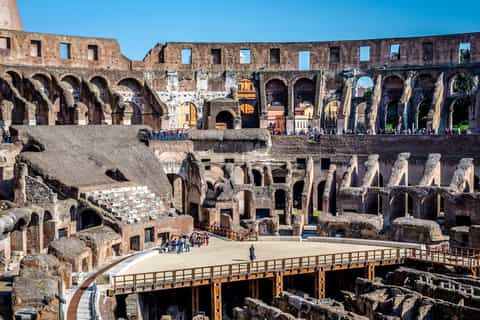
Colosseum Underground corridors and Arena Floor in Rome
The hypogeum was the working level beneath the spectacle. The arena audience saw dramatic entrances above them. Beneath their feet, corridors, cages, winches and lifting equipment made those entrances possible.
Read the archaeology

Two ideas that make the Underground much easier to understand

The ruins tell two stories at once: how spectacles were produced and how the Colosseum itself kept changing. Understanding both prevents the Underground from feeling like a collection of disconnected walls.

The operating system

People, animals and scenery had to move without being seen

The Underground separated preparation from performance. Corridors organised movement, while hoists and trapdoors connected the hidden service level to the arena above.

  • Lift shafts beneath the arena.
  • Corridors for controlled movement.
  • Winches, ropes and pulley systems.
The changing building

The hypogeum evolved as the Colosseum evolved

The masonry visible today belongs to a complex history of rebuilding. The subterranean system was altered after the amphitheatre’s inauguration and continued to change through its working life.

  • Early timber infrastructure.
  • Domitianic masonry rebuilding.
  • Later repairs and modifications.
Scale

Imagine the manpower

Official research describes an early system of 28 hoists that could require around 224 people when operated simultaneously.

Animals

Look for cage logistics

Wild-animal spectacles required animals to be held, moved and lifted into the arena without exposing the backstage process to spectators.

Perspective

Compare below with above

If your route reaches the Arena Floor, look back toward the Underground and match the hidden corridors to the performance space they served.

A better way to experience it

Use three questions while you move through the Underground

01 What moved through this space?

Ask whether a corridor or chamber was serving people, animals, equipment or movement toward a lift.

02 What was directly above me?

Keep relating the subterranean level to the lost wooden arena floor and the spectators sitting around it.

03 Is this original, rebuilt or reconstructed?

Separate surviving Roman masonry from modern walkways and reconstructions used to explain the ancient machinery.

Bookable Underground experiences

Three Colosseum Underground tours worth comparing

These three cover different priorities: an established wider Ancient Rome experience, a high-rated Arena-or-Underground option and a lower-starting-price 3-in-1 alternative.

Colosseum and Roman Forum tour with optional Underground or Arena access Most reviewed
★ 4.7 · 3,290 reviews*

Colosseum & Forum with Optional Arena or Underground Access

Useful if you want the Underground to sit inside a wider Ancient Rome itinerary rather than treating the hypogeum as your only archaeological stop.

From €99 per person*
View tour →
Colosseum Arena Floor or Underground guided tour High rating
★ 4.8 · 363 reviews*

Rome: Colosseum Arena Floor or Underground Tour

A useful comparison if your priority is one of the Colosseum’s restricted areas rather than building the day primarily around the Forum and Palatine.

From €99 per person*
View tour →
Rome Colosseum three in one tour with Underground option Lower starting price
★ 4.7 · 1,284 reviews*

Rome: Colosseum 3-In-1 Tour with Underground Option

A broader guided option with a lower listed starting price, useful for visitors who want to keep Underground access in the mix without choosing the highest-priced product first.

From €48 per person*
View tour →

*Prices, ratings, review counts, ticket variants and availability can change. In particular, some products offer Underground access only on selected options. Check the exact option shown on the booking page before purchasing. Some links are affiliate links; we may earn a commission at no extra cost to you.

Look beyond the headline

Four details that make the Underground more interesting once you are inside

The hypogeum rewards observation more than rushing. These four details help turn the route from “ancient tunnels” into a readable piece of Roman engineering.

01 · Follow repeated structural patterns

When similar corridors, shafts or openings repeat, look for the system rather than treating each ruin as an isolated feature.

02 · Keep looking upward

The key relationship is vertical: the Underground only makes complete sense when you picture the missing arena floor immediately above it.

03 · Notice where reconstruction helps

Modern reconstructed mechanisms can make ancient lift engineering easier to understand than masonry remains alone.

04 · Think like backstage staff, not spectators

Ask how animals, performers, scenery and workers could be moved efficiently while the public above saw only the finished spectacle.